My Invitation to authors was to compose a simple line of text. In many ways this request was akin to a techno-futurist thought experiment:
What would you like the machine to dream?
Project Abstract
Slow Down Time is a series of conceptual interactions that traverse geography, time and networked space through the exchange of text, image and data.
The works collected here represent the outcome of an international collaboration between writers, academics and artists working with the curator (aka The Prompt Wrangler) and a generative text-to-image service known as Midjourney.
Both an aesthetic and technical investigation, the project seeks to examine the procedural outcomes of generative AI routines as both standalone works of visual culture and mechanical bi-products of large language models (LLM). These models are trained on gigabytes of text-image pairs, a form of annotated archive scraped from the Internet.
Slow Down Time is an attempt – using curatorial and literary methods – at a conceptual response to that archive. The majority of text prompts are not the calculated compositions of a typical prompt engineer. Instead, they are mostly contemplative – quotations, throw away comments, existential questions, melancholic observations, whimsical thoughts and the occasional literary flourish.

Generative A.I. systems perform image requests in a matter of seconds, representing a new machine operation of hyper-seduction. Slow Down Time is a response to this manufactured desire for instantaneity and gratification in the near ubiquitous modes of digital media production and consumption.
Contemplation then becomes a key feature of the design process, occurring at numerous stages of the project’s life:
- the crafting of the prompt by the authors
- the gradual iteration of the images (over many hundreds of generations)
- the receivership of the curated images in printed form through the mail
- the author’s appraisal of those images as tactile media objects
Each step in the journey a deliberate measure to slow down time.
This iterative “slow-AI” method seeks to discern the character and the intention of the algorithm when responding to text prompts that are written in natural language by authors who assume human levels of cognition and emotion from Midjourney’s algorithmic system.
There is a presumption here – however misguided – that the algorithm is cognizant of the world beyond the network, that there is ‘human-like’ intention in the stylistic and compositional choices it makes.
Furthermore, at a nano-second level, is there some form of contemplation at work within the algorithmic black-box as it sorts through its appropriated cultural fragments at lightning speed?
A collaboration that iterates fidelity
from the noise within

The Project Journey
Invite / Imagine / share
- In August 2022, I reached out to colleagues, collaborators and various digital interlocutors
- I invited them to provide a line of text as a seed for a series of image compositions. This is known as a prompt.
Click / Save / Next /
- The Prompt Wrangler submits the text into a generative Artificial Intelligence which synthesizes the text into images from random noise in a process known as diffusion.
- From here, an iterative method of refinement and (r)evolution begins, each image generation building on the one before …
- The machine learns, the engineer refines, the curator looks on.
Print / Post / Wait /
- The collection is then curated into a series of editions, commonly derived from many hundreds of generated images
- These images are then printed onto photographic paper and posted by mail to the original prompt authors
- Authors are asked to respond to the images any way they choose – (emotionally, culturally, intellectually, technically, playfully) …
- The author’s email their responses back to the Prompt Wrangler who then posts them on the project site alongside the respective image collections
Copy / Paste / Print /
- The final step is public engagement with the works in traditional gallery and symposium settings.
- This includes video projections, gallery prints and domestic framing techniques with recycled and found materials
- Thus, the synthetic image merges with the everyday and the industrial art space
How did this come about?
The project evolved from a personal journey of recovery. During what had been (for mostly everyone) a pretty awful couple of years, I suffered a breakdown. It was PTSD, it was burn-out, it was grief. Being alone was nothing new, yet it felt inescapable, final.
As Melbourne’s rolling lock-downs of 2020-21 ensued, I spent many hours in ISO on a spectrum of modalities between fleeting discovery, tempered thought and maddening despair. I scribbled news headlines and cryptic verse on a white board. I compiled playlists and took hundreds of photographs of the sky.
I also found myself drawn to episodic TV that explored notions of the uncanny, of parallel universes, of looping time and persistent virtuality. This was my world in isolation, eight floors up in a concrete box: scribble / snap / skip / repeat.
I knew that I needed to somehow re-engage with the world. I knew the key was my screen practice. I needed a new seduction, a new aesthetic, a new dreaming – perhaps entirely new way of “doing” language?
And then, as if by some divine network intervention, along came Midjourney.
In the act of crafting prompts I discovered a strange yet addictive fascination. The stylistic and compositional tendencies of the code was indeed a most mysterious and alluring seduction. The questions I began asking of the algorithm helped me step back from the edge.
I soon realised that I wanted to share this with people I had been thinking about in absentia – friends, colleagues and other creative spirits – companions and collaborators many years removed. Folks I had worked with or had known fleetingly and brilliantly at various points in my life – across my education, their education, and our intertwined creative and professional lives.
Why not reach out and make contact?
Why not ask them for a prompt?
Why not bridge time through art making with machines?

Why?
I think the most fascinating aspect of this new process of visual culture production is the poetics of both the textual prompt and the final outcome. It begins and ends as a text. Within that loop various modes of receivership take place.
For me, while the outcome is inherently visual, the process feels like a literary one. Therefore, I was keen from the outset to work with former colleagues who possess a literary-minded creative instinct.
Although the process is ultimately a technological one, there was no need to be familiar with A.I. assisted art making. Although machinic and data-centric logics would seem to be increasingly understood.
At what cost AI?
If you are interested in the ethical debates and the technical processes at work within generative AI models, I am building a set of resources and contextual readings here.
Briefly, it should be made very clear that this project does not operate in a vacuum and is very aware of persistent and unresolved issues pertaining to the development and rapid proliferation of generative AI. Some of these are evident in the archive.
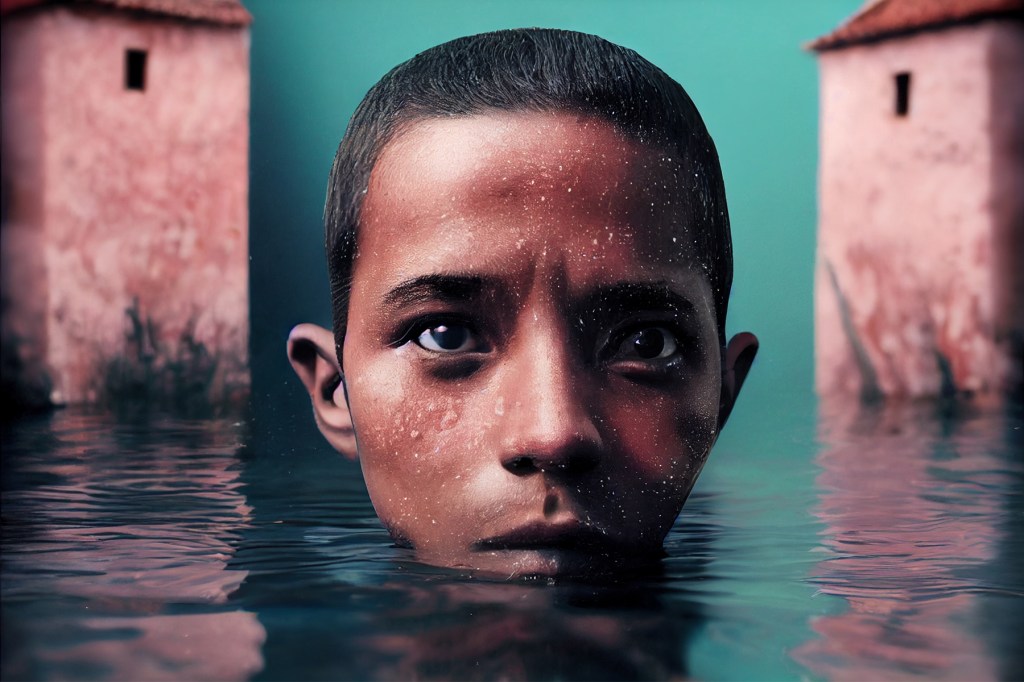
Midjourney Job ID # 62ddee07-ef3a-48bb-b6db-3a46d1ee8663
Broadly, we understand the key concerns to be:
Data Biases – Embedded inequality and prejudices within training data and the generative output – such as the depiction of racial, gender and cultural stereotypes
Worker Safety – The psychological cost of moderating training data and the filtering of violent, abusive and explicit content.
Worker Rights – The exploitation of vulnerable workers in the labeling and vetting of text-image pairs
Digital Rights – The unsolicited acquisition of copyrighted work by living artists for training data and in the output of generative processes (including concept, style and technique)
Ecological Impact – The server energy required to perform algorithmic calculations. The often exploitative mining practices used to extract rare minerals to construct chips and components.
/imagine
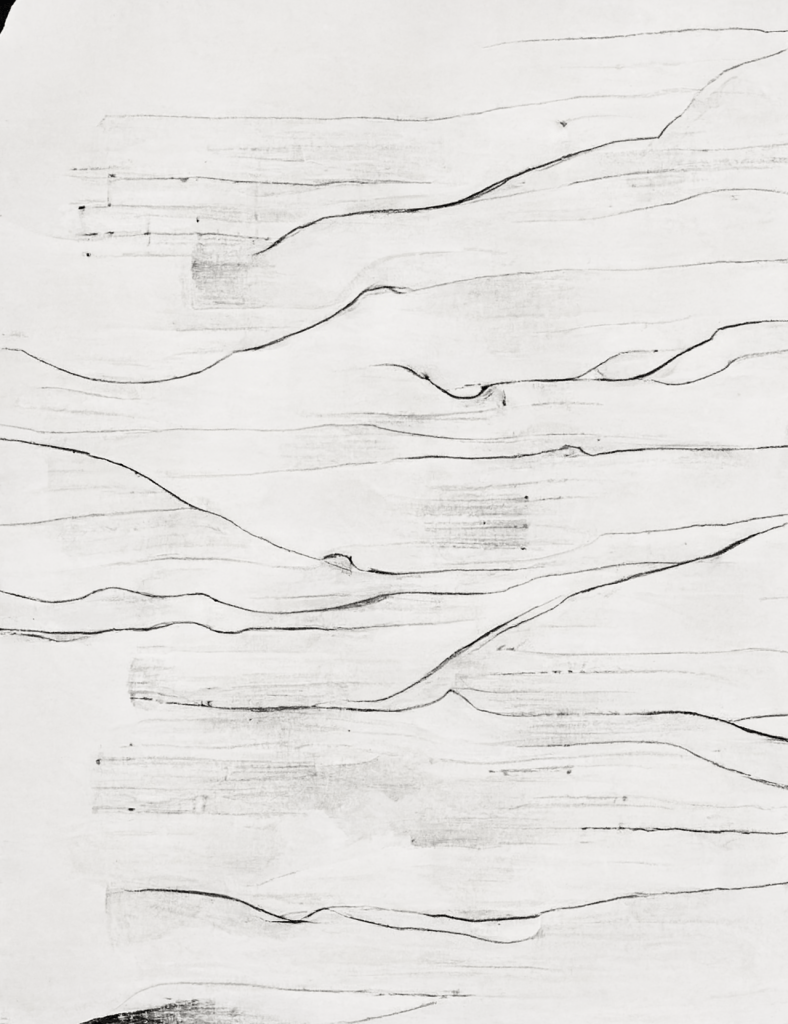
/imagine
A carpet of grass,
it is golden hour,
the future is everywhere
/imagine
I left, he stayed, we have been here before
/imagine
A warehouse, natural light, shipping crates, long shadows, hidden treasure, 1939
/imagine
A soup dragon glides across a rainbow, clouds like popcorn
/imagine
Something this way comes
/imagine
All the people, living for today
Get in touch
Thank you for your response. ✨

 Slow Down Time